Most people don't think much about their big toe until it starts hurting and even then, they're usually more focused on the heel pain, the aching arch, or the knee that keeps acting up. Here's the thing: your big toe is one of the most mechanically important joints in your body, and when it stops doing its job, everything above it starts picking up the slack.
Your Big Toe Has One Job — And It's a Big One
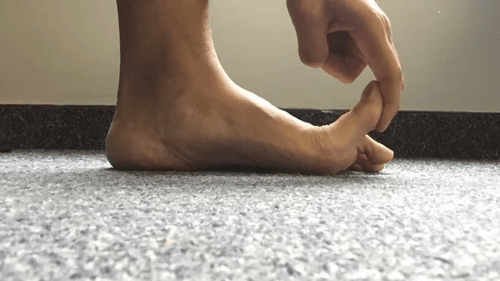
The first metatarsophalangeal (MTP) joint, the knuckle at the base of your big toe, needs to bend upward at least 60 degrees every time you take a step.[1] When your big toe bends during push-off, it triggers the windlass mechanism stiffening your arch and transforming your foot from a shock absorber into a propulsive lever in a fraction of a second.[1] If that motion is restricted, your foot never fully locks up, and you're essentially pushing off a wobbly platform with every step.[2] At the moment of push-off, your big toe bears 40–60% of your body weight, and during faster movements that force can climb to 2–3 times your body weight as you drive forward.[3]
When It Can't Move, Your Body Gets Creative
The body is remarkably good at finding workarounds which can sometimes lead to consequences. When big toe motion is restricted, you'll often see compensations such as an early heel lift, an outward foot swing during push-off, or a weight shift to the outer forefoot to avoid loading through the restricted joint.[2] These compensations happen automatically, usually without the person even noticing.
Over time, this can add up. Structures that weren't designed to carry extra load start complaining and that can contribute to heel pain or knee and hip tightness you've been feeling.[2]
So Which Is It — Functional, Structural, or Rigidus?
There are three related diagnoses here and the distinction matters because the treatment approach differs significantly between them.[3]
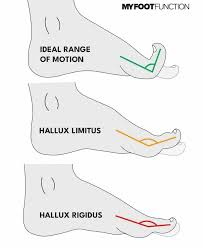
Functional Hallux Limitus
This is the sneakiest of the three. Sit down, and someone can move your big toe through a full, pain-free range of motion without any issue. But the moment weight goes through the foot, the joint locks up.[2]
The restriction is load-dependent; meaning it only shows up when the foot is actually doing its job in standing or weight-bearing activities. There's no structural damage, X-rays look normal, and the joint itself often isn't painful at all.[2] That's exactly why it gets missed. It's common in people with flat feet, hypermobile feet, or a tendency to overpronate and extremely prevalent in runners.[2]
Structural Hallux Limitus
Here the joint has actually changed. Early cartilage wear and the beginning of bone spur formation on the top of the joint means that motion is now restricted whether you're on your feet or off them.[1]
People typically notice stiffness that's worse in the morning, pain on top of the big toe joint during activity, and sometimes a visible bump where the spur sits. Trauma, repetitive stress, inflammatory conditions like rheumatoid arthritis or gout, foot structure, and family history are the most common contributing factors.[3]
Hallux Rigidus
This is the more severe stage where motion is heavily restricted or gone entirely. The joint is often visibly enlarged, daily activities like walking upstairs or squatting become difficult, and most footwear is uncomfortable.[3] It affects about 25% of people over 50 who present with foot problems, and is twice as common in women as in men.[3] It's typically the result of years of unaddressed structural changes progressing down the line.[1]
How Do You Tell Them Apart?
The key test is straightforward: how does the joint move with and without weight going through the foot?[2]
If the toe moves freely off the ground but locks up under load — that's functional hallux limitus. If motion is restricted in both situations and the joint is mildly stiff and tender — structural hallux limitus. If motion is severely limited or absent, the joint is stiff and painful regardless, and there's a clear bony bump on top — hallux rigidus is the likely culprit.[1,3]
A clinician can perform a simple hands-on loading test in the office, assess your shoe wear patterns for clues, and suggest weight-bearing X-rays if structural changes are suspected.[2]
Runners, Pay Attention
Running puts a lot more demand on your big toe than just walking around during the day. Every stride requires your toe to bend and push off forcefully, and when that motion is restricted, your body finds a way around it — whether you notice it or not.[2] Over time, those small compensations add up and whether you're jogging a few miles a week or training for a marathon, your big toe plays a bigger role in keeping you running well than most people realize.
The good news is that you don't have to be in serious pain to take notice. Sometimes the first signs are more subtle — one foot flaring out when you push off, a feeling that your stride is uneven, or a nagging injury on one side that keeps coming back no matter what you do. Functional hallux limitus in particular can be completely painless at the big toe itself, which is exactly why it often gets missed for so long.[2]
If you've been noticing issues with your big toe mobility, we got you. Schedule an appointment with one of our physical therapists before a small issue becomes a bigger one.