In the fitness world of 2026, "cycle syncing"—the practice of tailoring workout intensity to the phases of the menstrual cycle—has become a buzzword. Proponents often suggest a rigid schedule: high-intensity interval training (HIIT) and heavy lifting during the follicular phase (when estrogen rises) and strictly low-impact yoga or walking during the luteal phase (when progesterone dominates).So what does the research say?
Cycle Phases
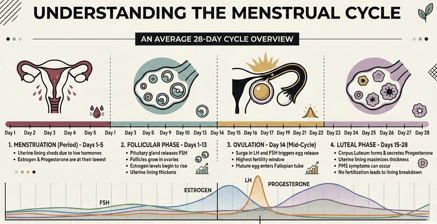
Before diving into the applications of cycle syncing, let's first review the phases of a normal menstrual cycle.
- Menstrual Phase (Days 1–5): The cycle begins with menstruation, where the uterine lining breaks down and sheds.
- Follicular Phase (Days 1–13): Starting from day 1, this phase overlaps with menstruation. Follicle-Stimulating Hormone (FSH) rises, causing an egg within a follicle to mature and prompting the lining to thicken.
- Ovulation (Day 14): A sharp surge in Luteinizing Hormone (LH) triggers the release of the mature egg from the ovary. This is the peak fertile window.
- Luteal Phase (Days 15–28): Progesterone levels increase, fully preparing the uterine lining for a potential pregnancy. If fertilization does not occur, hormone levels drop, leading back to day 1.
Does The Literature Support Cycle Syncing?
Logically, it makes sense that women may experience fluctuations in energy, strength and performance based on where they are in the cycle. However, recent high-level research, including a landmark 2025 study from McMaster University, has begun to debunk the idea that this timing offers a significant physiological "boost" to muscle protein synthesis or strength gains.
The physiological reality is more nuanced than a calendar can capture. A 2024 systematic review in MDPI noted that while some women may experience peak power near ovulation, the group-level differences in strength across the cycle are often "trivial." In fact, for many women, the luteal phase—often unfairly maligned as a time of weakness—can actually be a period of high cardiovascular resilience and steady-state endurance. Rigidly adhering to a "low-intensity only" rule during this phase might actually lead to missed opportunities for aerobic conditioning and metabolic health. In short, the literature has not found any significant connection between a specific phase of the cycle and a woman's performance and output. Therefore, we can assume cycle-syncing is not a science-based practice.

The Power of "Internal Load"
Knowing that there is no significant influence of your cycle on your training, the best thing that you can do for your body is to move the focus from external data (what day of the month it is) to internal load (how your body is actually responding). Your "feelings" of fatigue, joint laxity, or mental readiness is a biological signal that outranks any biosensor recommendation. If you are in your "high-energy" follicular phase but had a high-stress week at work and poor sleep, your nervous system is in a state of high demand regardless of your estrogen levels. Build your internal intuition and allow that to drive your training decisions.
This is called an autoregulated approach. This means having a plan, but giving yourself permission to adjust based on daily biofeedback. If the weights feel heavy and your heart rate is spiking earlier than usual, scale back the volume—not because of a phase on a chart, but because your body is telling you to. In contrast, when you wake up feeling refreshed and recovered, take advantage of those days to push your limits. This nuanced strategy prevents the "all-or-nothing" burnout cycle and ensures that your training remains a tool for longevity, rather than another source of stress.
Listening > Hacking
Biohacking strategies-like optimizing your sleep based on your chronotype-are rising in popularity and are here to stay. But if the concept of cycle syncing teaches us anything, it's that biofeedback-the old fashioned "listen to your body" advice"-is perhaps more useful and actionable than fancy tests or gadgets.
Not sure how to interpret your body's signals? Schedule an appointment with a physical therapist today. Email us at connect@motivny.com to get started.