
Introduction
Is there such a thing as offseason for runners? Most are in the sport for the love of motion, or easily quantifiable health benefits. As such, it’s not typical to take time off to build a base. But you should. Especially if you frequently race and have a fluctuating training program to match. Off-season training doesn’t mean you can’t run and isn’t a break from progress - quite the opposite. It’s a period of time to reflect on the needs of your body to address what’s limiting you from going to the next level, whether that’s running faster or easier to better enjoy the process.
To best strategize on how to base build, it’s first important to know what matters. Contrary to popular belief, in running, the majority of your forward propulsion actually comes from the muscles below the knee: the Achilles tendon and calf-muscle-complex (oh yeah, there’s more than one of them). Targeting that group is going to yield the best results, but it’ll take some doing.
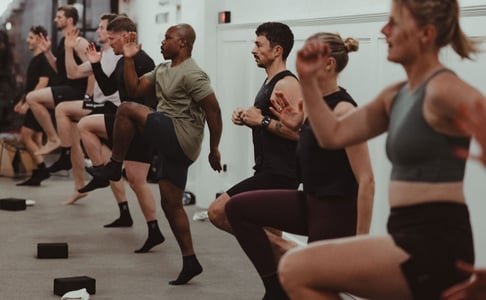
Section 1: Why Tendon Stiffness Is a Good Thing
When you hear the word “stiff”, you might think about the Tin Man trying to go for a run. But for tendons, this is a good thing. A stiff tendon is the most efficient in absorbing shock and propelling you forward. Training needs to try to address this feature. The more efficiently your Achilles tendon can absorb the weight of your body with each step, the better your running economy and durability, the 2 MVPs of faster running. So how do we do this?
Section 2: Soleus vs. Gastrocnemius — Why the Distinction Matters
First, let’s understand that your Achilles tendon and calf-muscle-complex is actually made up of 2 different muscles. First, the Queen muscle of running, the soleus, which is most active when your knee and ankle are bent as you bring your weight onto the forward foot. This one is a bit of a sleeper and one that we rarely see runners training in the gym. It’s responsible for absorbing over 4x your body weight with each step and contributes to more than 60% of the fibers in your Achilles tendon. It’s deep, (sitting on the back of your shin bone) and dominated by slow twitch fibers to keep your bopping along for hours. Its more recognizable partner, the gastroc, usually takes over at high speeds and inclines when you need push off power from a straightened knee.
Knowing the difference between these two muscle will allow you to effectively train them for what they’re good at.
.jpg?width=437&height=300&name=fw24-OnxMOTIVNY-pt-product_still-11%20(1).jpg)
Section 3: How to Actually Build Tendon Capacity
Our two primary training tools in the gym to beef up these muscles is:
- Heavy slow resistance (HSR): Weighted calf raises (both straight-leg for gastroc, bent-knee for soleus) performed at slow tempos of 3 seconds up, 3 seconds down. Slower loading tempo with high weight (goal is 1-1.5x body weight) leads to better adaptation than quick reps.
- Plyometrics and energy storage work: Once a base of HSR has been established, introduce double-leg and single-leg hops, jump rope, and bounding to train the tendon's elastic energy storage capacity. These are the qualities that directly translate to running performance.
As always, sequencing always matters. Don’t go straight to jumping and plyometrics without laying the groundwork through a HSR program. This will rob you of important gains and make you vulnerable to injury rather than adaptation.
Section 4: Periodizing the Off-Season
Here’s a simple approach for a 12 week offseason program:
- Weeks 1–4: HSR foundation — bilateral loading, higher reps, controlled tempo
- Weeks 5–8: Progressive overload with unilateral work — single-leg calf raises, deficit work
- Weeks 9–12: Introduce reactive and plyometric loading, reduce volume, increase intensity
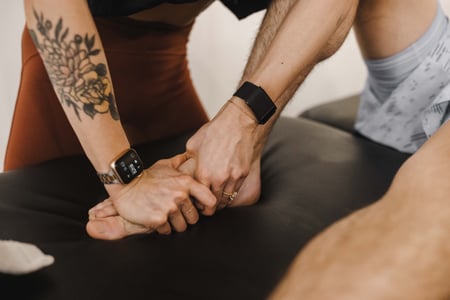
Section 5: How PTs Measure Calf Durability
Can you easily measure calf durability? Not really, but you can get a pretty good estimate by looking at run pacing data over long durations as well as some easy-to-do tests in the clinic.
-
>30 single leg heel raises with a 1 second up, 1 second down tempo.
-
Hop test for limb symmetry.
-
Isometric overload tendon load tolerance assessment.
These benchmarks can help assess what type of tendon work will be best for you.
Not sure how to interpret your body's signals? Schedule an appointment with a physical therapist today. Email us at connect@motivny.com to get started.
.jpeg)